The Choir of Holy Dormition Church
from the parish's Golden Jubilee anniversary publication (1957)
The Parish Choir
The choir of the Holy Assumption Russian Orthodox Greek Catholic Church has a history as eventful and as impressive as that of the church it has served for nearly fifty years. When the church was first organized the music consisted of unison singing by members selected to lead the congregation. They were known as readers and were familiar with the responses which were sung or chanted and which they had memorized through constant attendance at church services in the old country from which they came.
It was in the first year of the parish that Father Michael Pazdry attempted to show the parishioners that church hymns could be sung in the four different tones. His first attempts were in only three-part harmony because he just had two others besides himself who had some knowledge of reading music. The first attempt was in three-part singing—the Father sang one part, his brother sang another, and Mr. Groziak, acting as "diak," sang the third. Father Pazdry started to teach Mr. Groziak music and musical composition during the next year. Any spare time that they had was spent in studying music. The priests coming from Russia were well versed in vocal music and in conducting choirs as it was compulsory for them to study this when they trained for the priesthood. This was compulsory because the Orthodox churches do not have pianos or organs.
There were several young men and women in the parish with whom Father Pazdry tried to build a choir. Because these people were unable to read music it was difficult to build a choir. Father Pazdry left the parish in 1909 and Father Alexy Michalovsky came to serve the congregation. Father Alexy Michalovsky gathered the young children of the parish and interested them in a choir. These children had to be trained carefully because they had to be taught to read the Russian language as well as to be taught to read music. This was really the early beginning of the Parish School. The work was tedious and slow, but Father Michalovsky, assisted by Mr. Michael P. Groziak, worked with these children and results were soon forthcoming when they sang in church with the four different parts of harmony singing.
The children in that first choir were John Chulick, Eva Chulick, Mary Kehart, Mary Chulick, Rose Kehart, Martin Kehart, Ann Kolotila, John Kolotila, Anastasia Sosenko, Ann Sosenko, and Teklia Pucher. As children grew to the age of twelve they were brought into the choir.
It was in this manner that Father Michalovsky laid the foundation upon which the choir has been built and has existed to the present day. After Father Michalovsky left the parish the Fathers that followed kept up the work that he had started and the choir progressed.
As time passed and the parish grew, more children were brought into the choir and as the original members became more proficient in reading music the choir became a very good musical organization.
The library of church and secular music, sung by the choir, has compositions by such noted Russian composers as Tchaikovsky, Bortniansky, Ivanoff-Ipolitov, Rimsky-Korsakoff, and Rachmaninoff. These composers have composed the music for some of the regular hymns of the Orthodox Church.
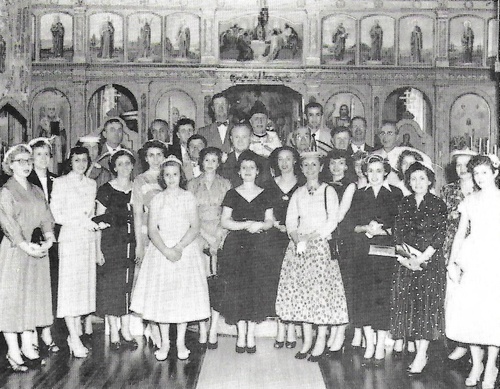
At the time of the visit of the Bishop, His Grace, Most Reverend Leonty, the choir did a magnificent job during the Mass [Divine Liturgy] that the Bishop served. After the Services His Grace commented that he was very much surprised and pleased to hear such a fine choir—so far west and in so small a community. He further told the congregation that it would compare with the best of the Russian church choirs in the country, even those of the large cities and at the Orthodox cathedrals. This was a very fine tribute to the choir of our small parish.
The choir of the church at Madison joined with the Benld choir during the days when one pastor serviced both churches, having services in Benld one Sunday and in Madison on the next Sunday.
The Immigrants-All-Americans-All Program at the State Armory at Springfield was produced by one of Benld's former citizens, Mr. Avinere Toigo. This was a great program, showing the contributions of various nationalities to our American culture. The combined choirs of the Madison and Benld Parishes gave a very good concert at that program. The concert was very well received by the throng that jammed the Armory that night.
The choir has given many concerts for the benefit of the parish and it has performed at many community functions. It has given concerts at school baccalaureate services, at P.T.A. programs, at homecoming programs, and their own programs at the Grand Theater in the past.
During the years of World War II there was a great lull in the activities of the choir. Many of its members were gone. Activities of the choir started in earnest after the war. Father Lopushinsky built up the interest again as the boys returned and it again was one of the best musical organizations in this part of the state.
Today [1957] the personnel of the choir is small because many of our members have had to move to seek employment elsewhere. However, on Church Feast days when many ex-members return home, membership of the choir swells, old familiar voices ring out, and it reminds one of the time when the choir was made up of some forty-five members.
The above text was excerpted from the 1957 Golden Jubilee Holy Assumption Russian Orthodox Church publication by parish members for the celebration of July 26, 27, 28, 1957. Only minimal adjustments have been made to the original text (such as correcting typographical errors and adding clarification in brackets of alternate transliterated spellings).
Notes
- The program referred to above was likely the "Americans All, Immigrants All" program, which was a 26-week educational radio broadcast series that aired on CBS from November 1938 to May 1939. It was created to promote national unity, counter rising intolerance, and highlight the contributions of various ethnic and immigrant groups to American history and culture. It was produced by the U.S. Department of the Interior’s Office of Education in partnership with CBS, the Works Progress Administration (WPA), and other groups.