History of the Holy Dormition Orthodox Church - The First Fifty Years
from the parish's Golden Jubilee anniversary publication
Beginnings of the Orthodox Community in Benld
Early in the second year after the turn of the century Mr. Andrew Sosenko was traveling westward. It was his intention to travel to Montana or Wyoming to find employment and to find a place to settle with his family. While aboard a train heading westward, he overheard a conversation. Two men were discussing employment and the conversation was quite loud, so Mr. Sosenko decided to do some eavesdropping. He heard the men discussing the opening of a new coal field in Macoupin county, Illinois, some fifty miles from St. Louis. As he was interested in employment, Mr. Sosenko slowly worked himself into the conversation and endeavored to get as much information as possible.
Upon arriving in St. Louis, Mr. Sosenko decided to come into this area and look around. When he arrived he found that a new coal mine was in operation and that still another two mines were planned. He also learned that a new settlement would grow around the few homes that at that time stood here. After thinking it over, he decided to remain here to seek employment and to settle. He liked the idea of being a part of a new community and he saw an opportunity to notify his friends and relatives in the eastern states of what he had found. He wrote letters to all of his friends in the coal fields in Ohio and Pennsylvania. He also notified his family and relatives where he intended to settle and told them of the opportunity for employment in this area. He told them of the mines already in operation in this part of the county and of the new mine that was opened and of those that were being planned. Thus he spread the word to the Slavic peoples of those areas that there was a golden opportunity for them here in this section of Macoupin county, Illinois.
Mr. Sosenko's convincing letters were quickly answered from the eastern states. Several of his friends followed him here quickly and liked what they found. They, in turn, wrote to others and within a short time many Russian families had migrated to Benld. What little they found here back in 1902 and 1903 they liked and in turn spread the word to friends and relatives in the eastern states, as well as in Europe. Many families came straight from Europe to Benld. By the beginning of 1907 about forty Russian families had settled in Benld and these expected more of their friends and relatives to follow them. Thus a large group of Slavic people moved into this community. Many of their descendants still live here. Others have moved to all sections of the United States, but they still talk of Benld as home.
These people have lived and worked in this community, built homes, founded an Orthodox parish, reared their families and added their customs and ideas to the ever mixing culture that we find in our great country. They have taken part in the building of this city, and many of them have served on the city council and held various other offices of the city.
A Short History of the Parish
On March 3, 1907, beginnings were made toward establishing a parish at Benld for the Orthodox Christians. Having left their homeland and settled among strangers, the realization suddenly dawned on our immigrants that there was not a spot where they could gather and exchange views. The Sundays were particularly lonely, for there was not a designated place of worship. Since childhood they were used to meeting and going to church together.
These pioneers were appalled. Their children would soon grow up as strangers to their ways of life. An organization, the germs of which began to take hold, was quite an undertaking. Someone advised that at Streator, Ill., there was a Father Potochny who could be contacted for advice.
Father Michael Potochny agreed to come and to give counsel as to how to make the beginnings for a place of worship. Fund raising was not easy. The people were spiritually rich but materially poor. But where there is peace, faith, and agreement, all will succeed. And so it came to pass that the organizational meeting was called.
The first meeting was not too well attended. It took place under a tree, and not too much was accomplished. But the seed was sown, and the spirit moved them to have a second meeting at the home of George Schur. So that an idea might not die, immediately thirty-one persons pledged sums of money ranging from five dollars to fifty dollars, making a total of nine hundred fifty dollars. The honor roll of the first donors reads thus: William Sosenko, Andrew Sosenko, Michael Wasylenko, Peter Kolotila, Joseph Zboyovski, Peter Schur, George Schur, Peter Poliansky, Theodore Homyk, Mitro Drahusky, Sam Vladika, Andrew Dmytryk, Wasyl Chulick, Alex Chulick, Peter Honchak, Ignatz Berezik, Gregory Kotanchik, Mike Madzelian, Nicholas Madzelian, Sam Sabot, John Slota, Mitro Tyhanich, Jacob Senko, John Senak, John Nebesnick, Peter Nebesnik, Steve Zubanich, Nick Mikuletz and Steve Senko.
Within a very short time this group grew when the following joined them in their endeavor: Mike Groziak, John Skuba, Paul Pellock, Sam Katrenich, Pete Frensko, Nick Frensko, Wasyl Russen, Philip Kurilovich, Wasyl Shevchik, Ignatz Turco, Onifer Sabot, Nick Simm, Wasyl Kehart, Nick Kasich, Alex Tyrpak, Eustin Dubetz, Mike Halechko, Wasyl Plaskon, Pete Plaskon, Mike Plaskon, Maxim Pittlosh, John Bawalock, Pete Slota, John Kasich, Frank Lopishak, John Puchar, Andy Bawolock, Wasyl Chaklosh, Mike Chulick, Mike Dmytryk, Mike Frensko and Mike Komanetsky.
And from these beginnings there has existed for fifty years the Holy Assumption Russian Orthodox Community, progressing steadily under the spiritual guidance of its priests. At times, of course, there have been misunderstandings and growing pains. Weeds grow in the the garden under the sun that nourishes all alike. But the church today stands on a firm foundation.
A frame church, it seemed, would be satisfactory to heal the hurt of the struggling miner and his family. Construction on the building was started in the summer of 1907 and the cornerstone was laid in the summer of 1907. Great was the joy in the parish when the church was finally completed.
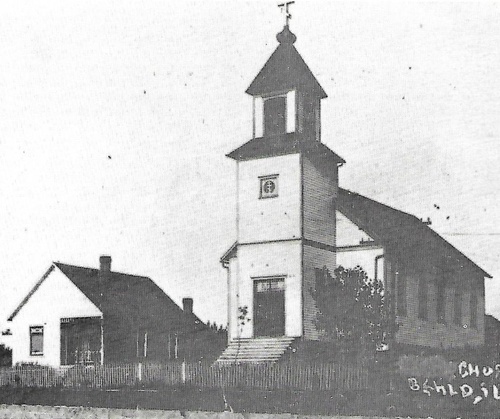
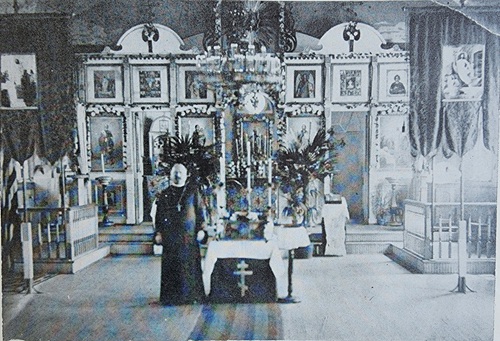
Just as the parish was getting a good foothold and progressing rapidly a catastrophe of great magnitude came about. On the 20th day of July, 1915, on St. Vladimir's Day, the church was burned to ashes. Even the relics of the saint burned. Nothing was saved. Help came but to no avail.
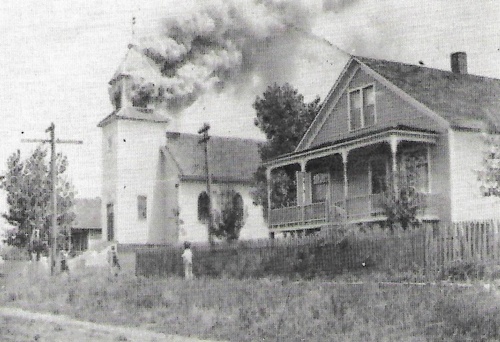
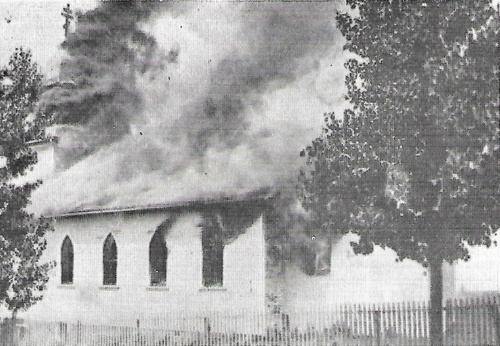
The first church had the rarest of trappings, a begemmed Bible, standards and banners sewn from the rarest materials in the true Byzantine style. The entire set of books was in the Synodical Editions. All of these had come as a gift from the Czar of Russia to the people of the Benld parish. The vestments, trimmed magnificently in gold and silver, disappeared forever.
Great grief came to the hearts of the communicants. What to do? But the spirit does not die. With the church, the parish home and the furniture gone, there was but one thing to do--start all over again. Another collection and much more toil and labor, and a pledge that instead of a wooden one a brick building would be built. And so a beautiful brick building went up and stands today as an ornament to the entire community.
To mention all that has happened would require a book. Unnecessary details are left out, such as the schisms, and the split in jurisdiction. After careful thought and much regard for the ancestors both here and abroad it was decided that the church must remain truly orthodox and keep its alignment with the Mother Church.
The church has not been without its enemies. On one occasion the windows were broken out and a night guard was immediately set up in fear that the church might again be burned. But it may be said in the words of the Apostle Peter, that men with a strong will who stay on the right path cannot be shaken in their faith. And so the trouble makers were led to see the light.
As it was so difficult for a small group to pay all expenses, the Central Diocesan Committee in Russia agreed to help the struggling parish and paid one-half of the wages of the priest. This help from abroad continued until the Parish became large enough to be self-sustaining.
Mismanagement of the resources of the Parish has at times been at the root of difficult periods, but with the upbringing of the children in the atmosphere of a good community, good schools, and honest business dealings, the financial status of the organization, thanks to capable people, has reached the status of financial independence and has won the respect of the community.
All due respect goes to the little educated miner and community pioneer who gave tithes and managed affairs when called upon to do so to the best he knew how without the benefit of training. How indifferent, in comparison, are some of the younger generation who fail to give of their energies toward the fulfillment of spiritual enlightenment in a bemuddled world. Nevertheless it may be said with joy that the majority of the second generation of the builders of the church and those that came later attend the church in the tradition of the founding fathers. They guard jealously the trappings and the traditions of the church.
What a debt is owed to Father Gress who painted Ikons and decorated the church, ending his life here in his artistic endeavors. The church has since been redecorated, having become besmudged by smoke and grime from a leaky furnace. The redecoration has been done by Father Kowalchuk and Mr. Mike Makuh.
The improvements to the property of the parish were started energetically in the year 1947 under the guidance of Father Lopushinsky. During the last ten years many worthwhile projects have been completed. These projects include the following: The church building has been tuckpointed. New steps have been built both in front and in the back of the church. The old stage in the church basement has been removed in order to give more room in the banquet hall. New lighting fixtures have been installed in the banquet hall. A modern kitchen has been built and equipped under the altar. A candle storage room has been provided, and a large new furnace has been installed. A new canopy has been placed over the front door.
A second so-called hall was added by excavating under the entire home. This has enabled the parish to hold larger gatherings. The home has been completely modernized and remodeled. The remodeling of the entire interior has provided a church office, a bathroom, and a modern kitchen. The porches have been enclosed and revamped in the process. New furniture has been provided to equip the home. A new roof was put on the parish home.
A large block building was constructed. It serves as a garage and a storage room. The yard was graded and the lawn planted. All of this work with the exception of the front steps and the tuckpointing was done by the members of the parish. The Saint Barbara's Sisterhood has contributed more than its share of funds and hard toil at banquets and fund raising activities to help the parish progress.
As a place of rest, the parishioners have a plot of land all their own, adjacent to the city cemetery. Many of our number already lie there. Our numbers dwindle but we seem to grow stronger as time goes on. Who knows--there may be a new surge of members in the not too distant future, OR we may just gracefully die out, leaving a glorious memory to the eons of time.
The church records [as of 1957] show that 674 were baptized in the parish, seventy-five marriage ceremonies were performed and that two hundred and five were buried.
The Church Committee — 1957
| Name | Role |
|---|---|
| Rev. Sawa Kovalchuk | Pastor |
| Mike Makuh | Cantor |
| John W. Chulick | President |
| Paul Pellock | Vice-President |
| Mike Skuba | Financial Secretary |
| Walter J. Chulick | Recording Secretary |
| John Schur | Treasurer |
Trustees — 1957
- Mrs. Ann Muich
- Mrs. Ann Chaklosh
- Miss Julia Schur
- George Sehuta
- Mike Dmytryk
- Koscho Chowanec
- John Komar
- John Katrenich
- John Nemesh
- Mike Frinsko
- Michael A. Dmytryk
- Andrew Pawelczak
- Pete Skuba
- Steve Komanetsky
For further reading, see Parish History (Part 2) 1957 to 1987.
The above text was excerpted from the 1957 Golden Jubilee Holy Assumption Russian Orthodox Church publication by parish members for the celebration of July 26, 27, 28, 1957. Only minimal adjustments have been made to the original text (such as correcting typographical errors and adding clarification in brackets of alternate transliterated spellings).
Notes
- The Golden Jubilee parish publication clearly states that July 20, 1915 was the date of the burning of the first, wooden church. However, Wikipedia stated (in August 2026) that the fire occurred on July 27, 1915, citing as its source: Duncan, Mary (Feb 19, 1972). "How St. Mary's Came To Benld". Alton Evening Telegraph. p. 7. The feast of St. Vladimir is on July 15th (28th). None of the stated dates of the fire that we have found in our research correspond exactly with the Orthodox calendar feast day of St. Vladimir.