The Early Sister Churches of Holy Dormition Church
from the parish's Golden Jubilee anniversary publication (1957)
The Witt Parish
The Hungarian Russian Autonomy Greek Catholic Church of Witt, Illinois was organized on July 12, 1912. It flourished; and then on March 31, 1921, the congregation changed the name to St. John's Russian Orthodox Greek Catholic Church of Witt. The parish grew, and at its peak had 84 members. Then it dwindled. Some of the communicants moved from the community. Later the organization lost part of its membership to the Roman Catholic Church. The group got too small to keep the church open and it was closed in 1935. From 1935 until 1949 the parish was served by the pastor of the Benld Parish, and on one occasion the entire Benld choir traveled to Witt in a bus with the Pastor to conduct services. The church building was sold in 1951.
In 1950 when it was apparent to the parish that the congregation was too small to reopen the church and as they realized it would have to be sold, one-half of the furnishings of the church were donated to the Benld Parish.
After the building was sold the remaining members were accepted into membership with the Benld communicants.
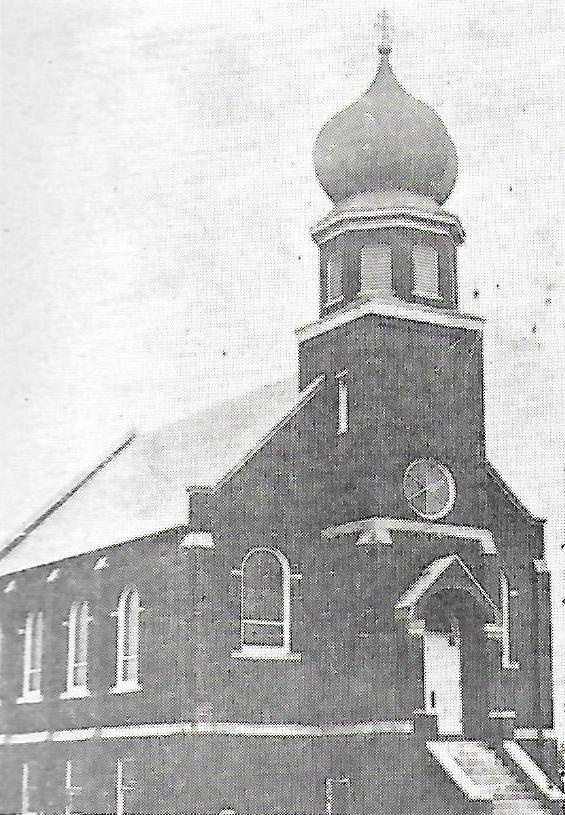
St. Michael's at Livingston
Saint Michael's Uniate Greek Catholic Parish was organized in 1916 [in Livingston, Illinois]. A priest came to serve the parish from St. Louis, Missouri. Early in the days of this parish the congregation realized that because there were so few of them they could not keep the parish going. So they decided to call a meeting of all the Slavic people of the community. Many of these Slavic people were of the Orthodox faith. The people at this meeting decided to change the name to St. Michael's Russian Orthodox Greek-Catholic Church. The first Orthodox priest to serve the parish was Father Kingskof of the Madison parish. He traveled from Madison to hold services.
Father Okaly came to serve the parish as the first resident pastor. He worked diligently and through his efforts and the help of Bishop Steven Jubie the parish was turned over to the Orthodox faith during the year of 1917. The parish flourished during its early days.
A Russian lodge was organized on November 3, 1919, by Father Okaly. A charter was issued as the St. Nicholas Lodge Number 140 of the Russian Orthodox Catholic Aid Society of the United States of America. This lodge insured its members. At its peak it had as many as fifty members. After the decline of the parish many of its members transferred to lodges of this Society in the different localities to which they had moved. The remaining members transferred to the Benld lodge of this society.
Late in 1919 Father Katchmarsky came to serve the parish. Then Father Ramzam of the Witt parish served the parish. He was followed by Father Brosisov and Father Karafom.
Later an agreement was made with the parish in Benld to have the pastor of the Benld congregation come to Livingston to hold services on the fourth Sunday of the month. This was during the time when Father Barna was pastor of the Benld congregation. This arrangement went on for some time.
The Livingston parish dwindled when many of its people had to leave the community to seek employment elsewhere. Those who remained realized they could not keep the church open, so they decided to close the church and to attend services either at the Benld church or the Madison church.
In 1934 the church building was rented to the Lutheran parish for three dollars a month. On the eighth of October, 1944, the church building was sold to the Lutheran parish for the sum of seven hundred and fifty dollars. With the consent of His Grace the Most Reverend Leonty, Bishop of Chicago, the money from the sale of the church building was divided into three equal parts of two hundred and fifty dollars. One part was donated to the Orthodox parish at Benld, the second part was donated to the Orthodox parish at Madison, and the third part was kept by the group for the upkeep of the Orthodox cemetery in Livingston, IL.
After the closing of the church the members of the congregation joined as members of the Benld parish or as members of the Madison parish.
The above text was excerpted from the 1957 Golden Jubilee Holy Assumption Russian Orthodox Church publication by parish members for the celebration of July 26, 27, 28, 1957. Only minimal adjustments have been made to the original text (such as correcting typographical errors and adding clarification in brackets of alternate transliterated spellings).
Notes
- Witt is a small city in Montgomery County, IL, in the west-central Illinois coal belt. It came into being in the early 1870s along the route of the railroads pushing south out of Springfield, and was reportedly named for an officer of the railroad rather than for any early settler. Like its neighbors along Illinois Route 16 — Nokomis, Ohlman, Coalton — Witt grew around shaft coal mining in the late nineteenth and early twentieth centuries, drawing immigrant families from Eastern and Southern Europe who supplied much of the mine labor. The decline of deep-shaft mining in mid-century shrank the town steadily, but Witt remains an incorporated municipality today, its population far below its coal-boom peak. The population of Witt peaked at about 2400 people in 1920 and was about 1100 in 1950.
- Livingston, Illinois is a very small village in the northeast corner of Madison County, set amid the agricultural land east of the Mississippi River bluffs. It is located along Interstate 55 about 37 miles northeast of St. Louis, MO, and close to Staunton, IL. It was established in the late nineteenth century as a coal-town satellite of the broader Edwardsville-area mining economy, and its population historically included many families of Eastern European descent who worked the surrounding mines — the same migration pattern that seeded Carpatho-Rusyn and other Orthodox communities in nearby Macoupin and Madison County towns such as Benld, Mount Clare, and Highland. As the mines closed, Livingston became a quiet residential crossroads village, notable to historians chiefly through the religious and family ties its former residents maintained to neighboring parishes. The population of Livingston peaked at about 1440 people in 1930 and was about 1000 in 1950.